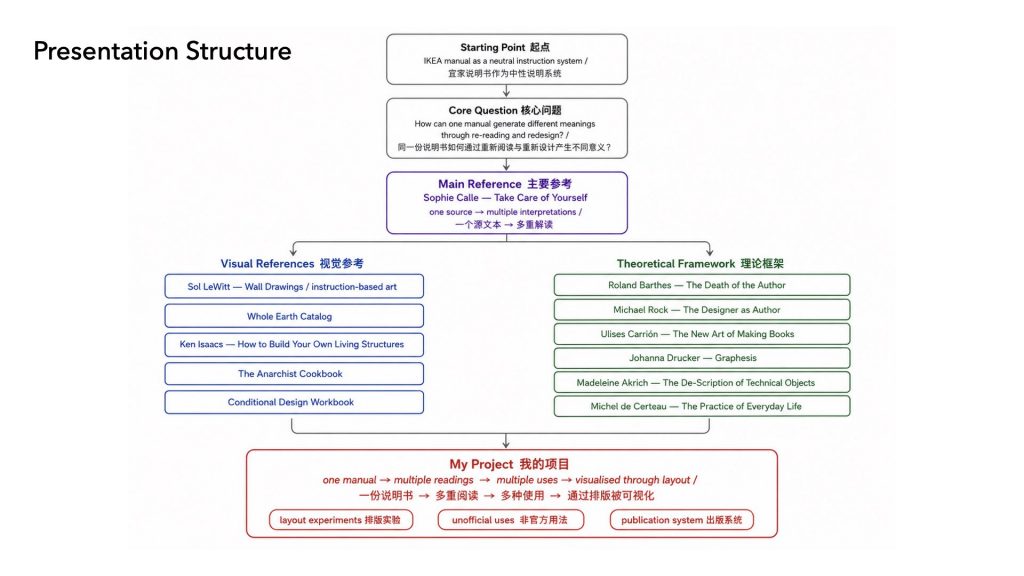
First, I’ll briefly look back at my previous project, and introduce a new question that came out of it. Then, I’ll share some key references and explain how they helped me build the context and methods for my current work. Finally, I’ll show some simple visual experiments, which reflect my current position.
To sum up my last project in one sentence: I was interested in how the same IKEA manual could produce different identities and meanings through changes in layout, reading order, and publishing format.
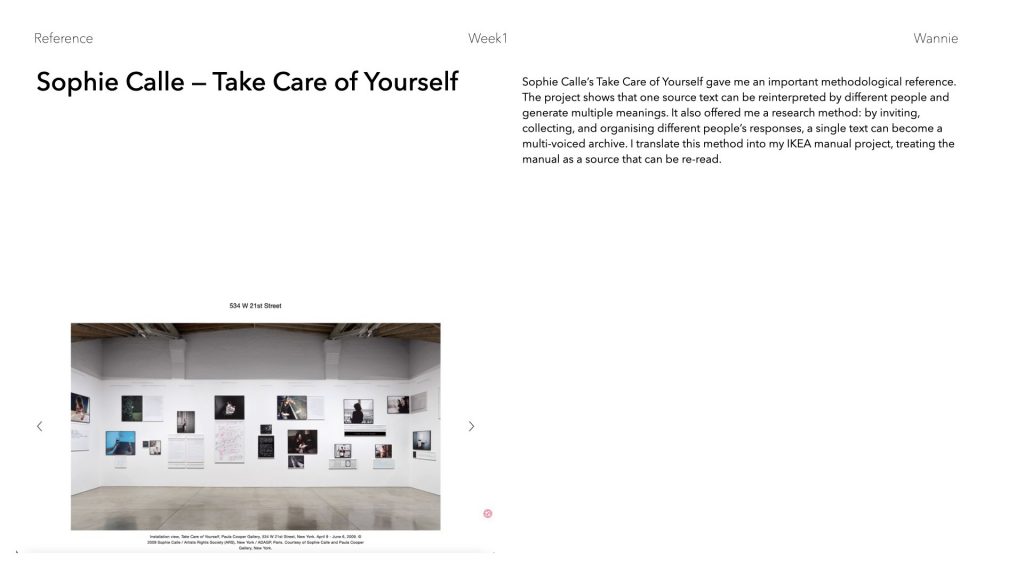
At that stage, I found Sophie‘s Take Care of Yourself very useful as a reference. In this work, she gives the same text to different people, and each person reads, interprets, and responds to it from their own position. For me, what was important was not only the final responses, but also her method: inviting people, collecting their reactions, and organising these different readings into an archive.
This made me think about my own project in a new way. If an IKEA manual looks neutral and objective, and if it assumes an ideal user, what happens when this same manual is given to different real users?
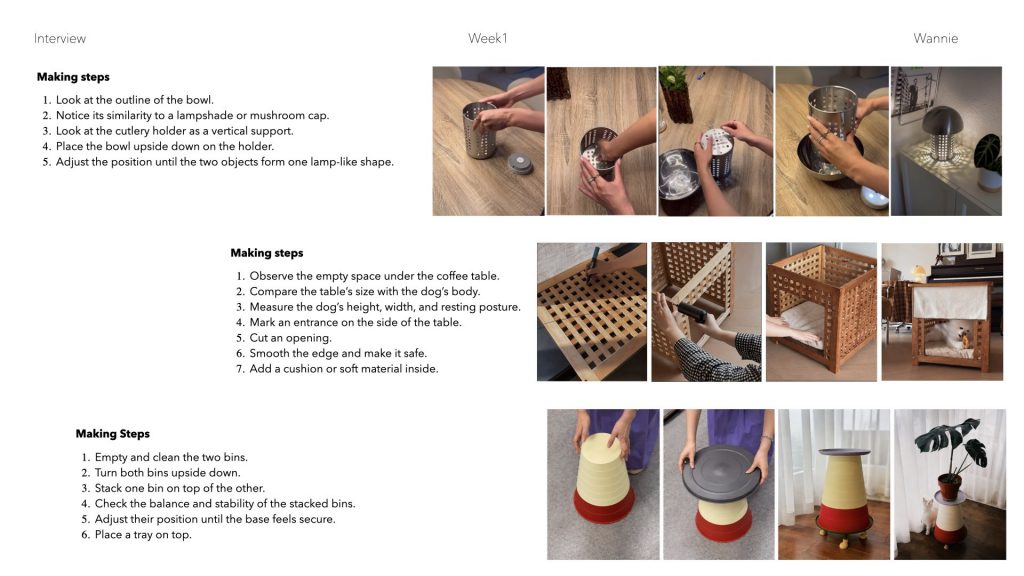
So I began to use interviews, collection, and documentation as part of my method. I collected three examples of users who changed the function of IKEA objects in their own homes. For them, the manual was not something they had to follow exactly. It became more like a reference point. Based on the official instruction, they created their own new steps, and in doing so, they changed the identity of the object.
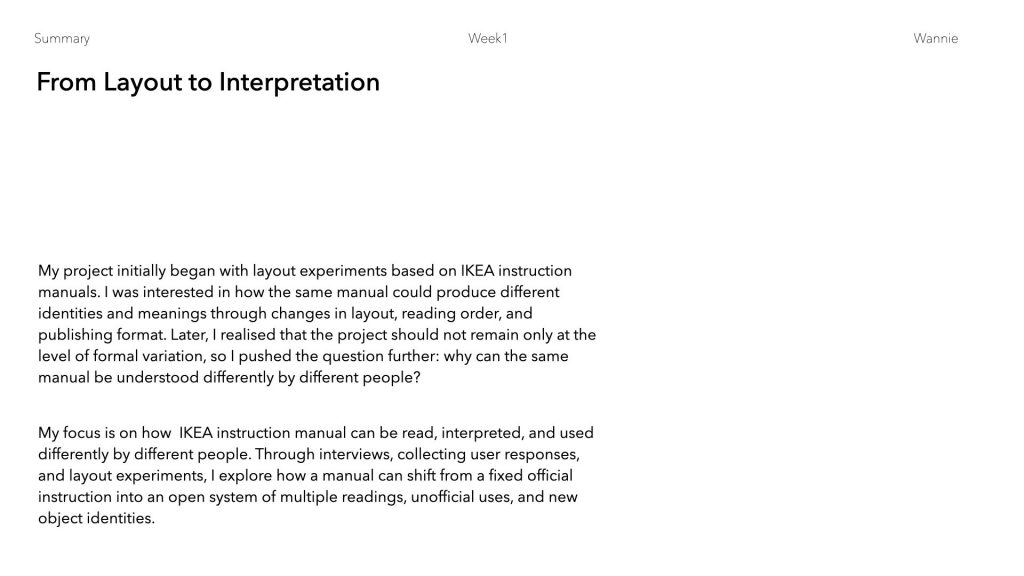
So, to summarise my current project:
My project started with layout experiments based on IKEA instruction manuals. At first, I explored how the same manual could create different identities through changes in layout, reading order, and format. Later, I shifted my focus from form to users: why do different people understand and use the same manual differently? Now, through interviews and layout experiments, I explore how an official manual can become an open system of different readings, unofficial uses, and new object identities.
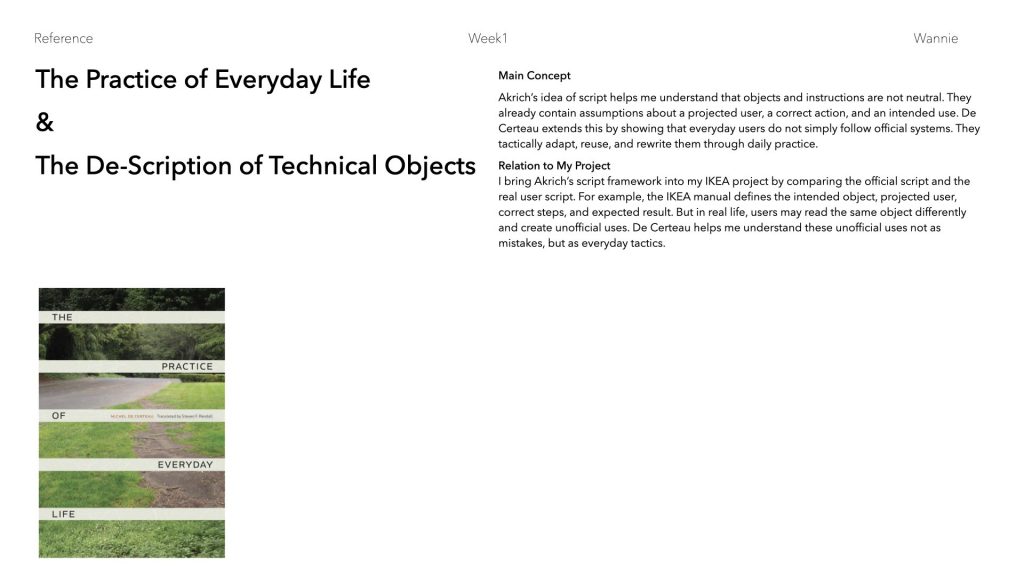
These two references helped me place the personal interviews into a clearer theoretical framework. Both of them discuss how a technical object carries the designer’s imagination, but also how this imagination can be rewritten by users in real life.
In The De-Scription of Technical Objects, she introduces the idea of the “user script”. She explains that designers often imagine a projected user: who will use the object, what abilities they have, what environment they are in, what sequence of actions they should follow, and what counts as correct use.
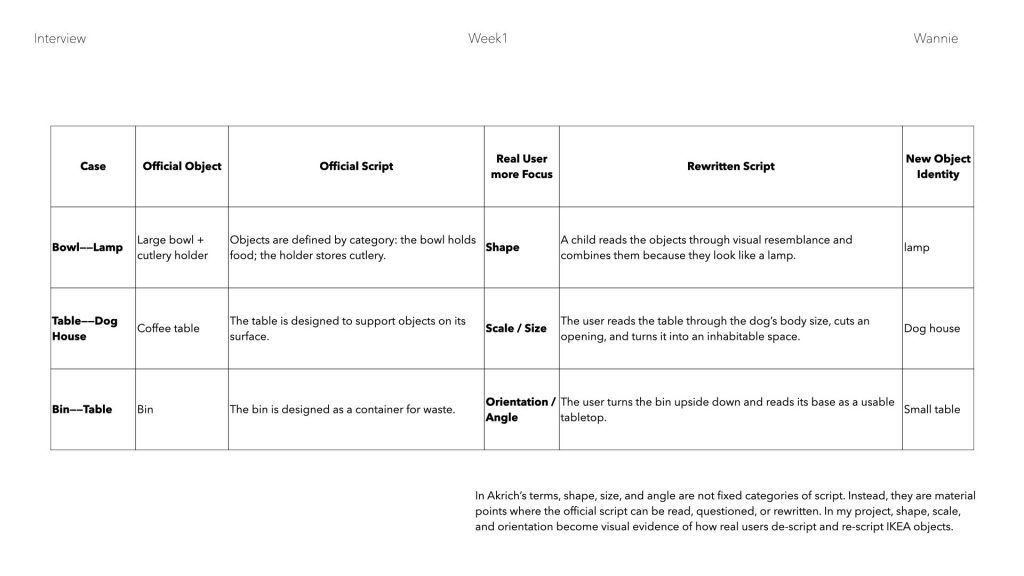
I used this framework to look at my three interviews. It helped me understand that these unofficial uses are not just some random examples. They show how real users read, question, and rewrite the script of an object.
In Akrich’s terms, shape, size, and angle are not fixed categories of script. Instead, they are material points where the official script can be read, challenged, or rewritten. In my project, shape, scale, and orientation become visual evidence of how real users de-script and re-script IKEA objects.
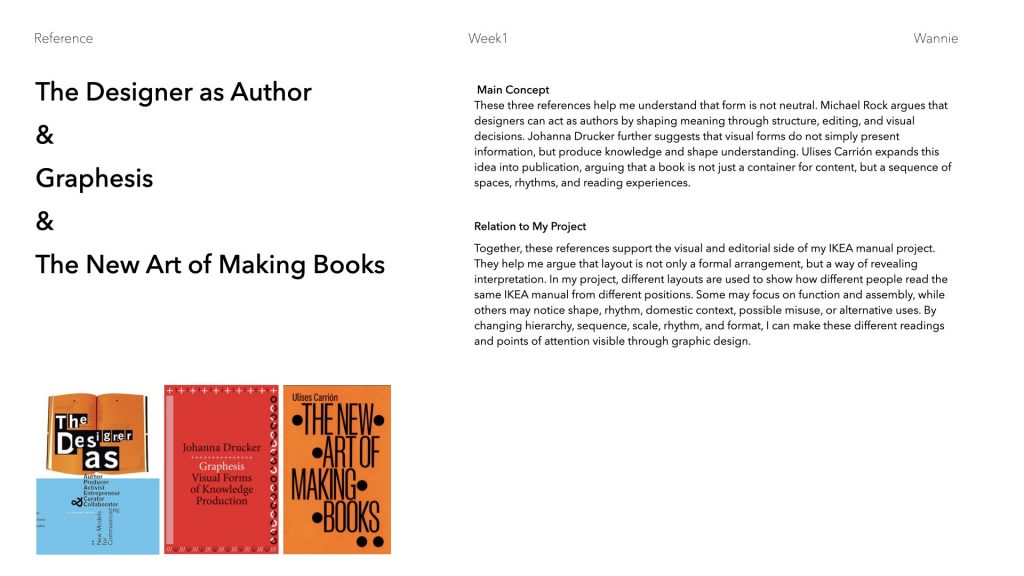
From these references, I also started to think about how layout can express different people’s scripts. Layout is not only a formal arrangement. It can also reveal interpretation. In my project, different layouts are used to show how different people read the IKEA manual from different positions. Some users may focus on function and assembly. Others may notice shape, rhythm, domestic context, possible misuse, or alternative uses.
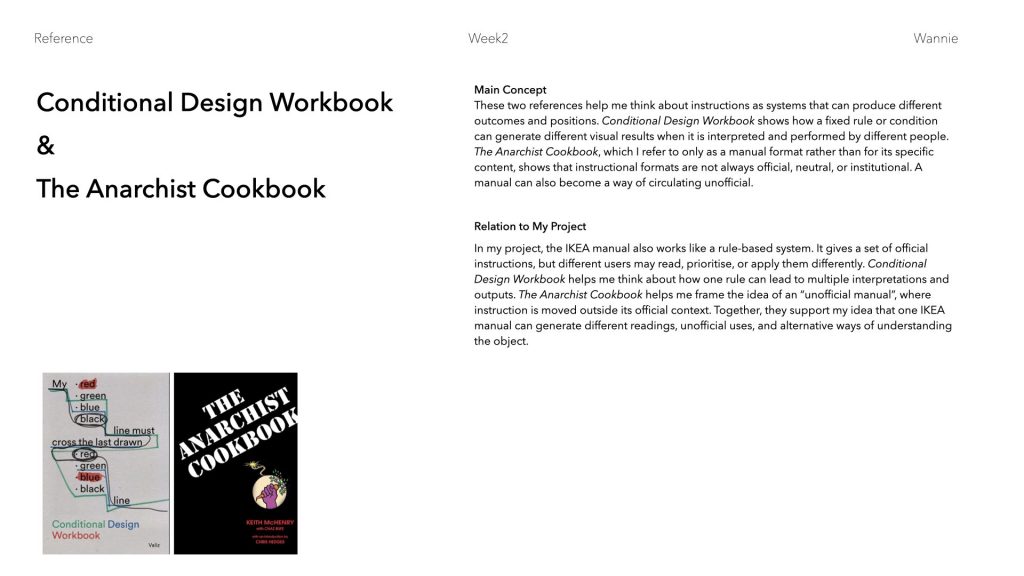
In my project, the IKEA manual also works like a rule-based system. It gives a set of official instructions, but different users may read,or apply them differently. Conditional Design Workbook helps me think about how one rule can lead to multiple interpretations and outputs. The Cookbook helps me frame the idea of an “unofficial manual”, where instruction is moved outside its official context.
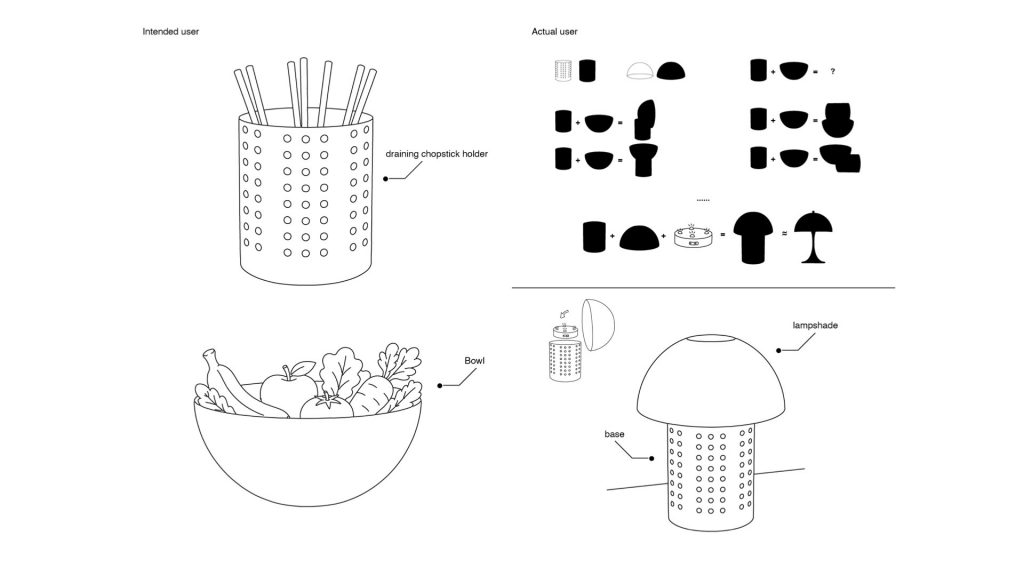
Here are some of my visual experiments.
I wanted to use different layouts to show different user scripts. When different users look at the same kind of instruction, they focus on different things. These different points of attention then lead to different results.
For example, one real user combined a chopstick holder and a bowl to make a lamp. This happened because they noticed that the shapes of the two objects could fit together. For this user, the most important thing was not the original function, but the shape.
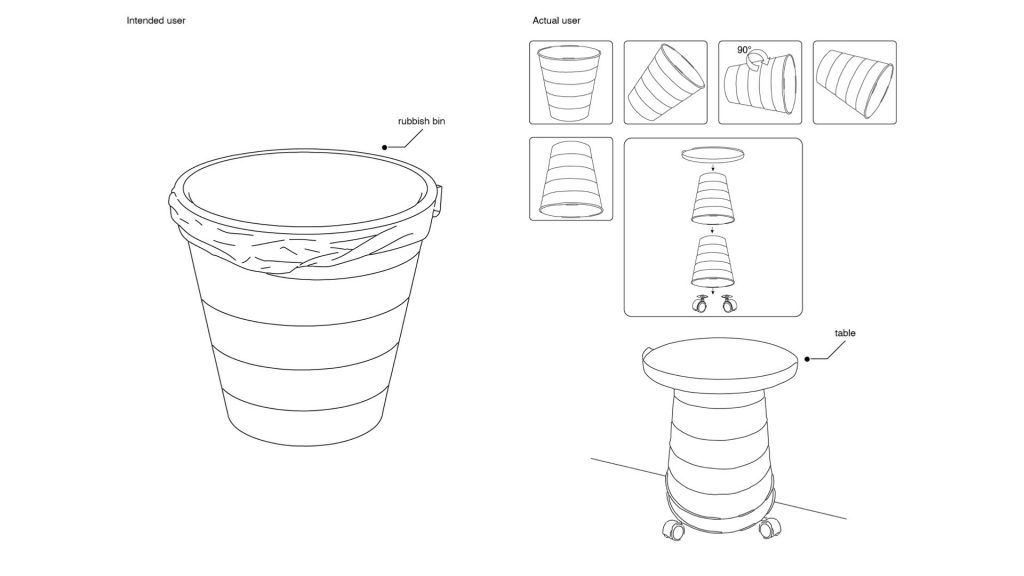
Another user turned two bins into a table by stacking them and adding a tray on top. In this case, the user paid attention to the angle and orientation of the object. By turning and repositioning the bins, they created a new function.
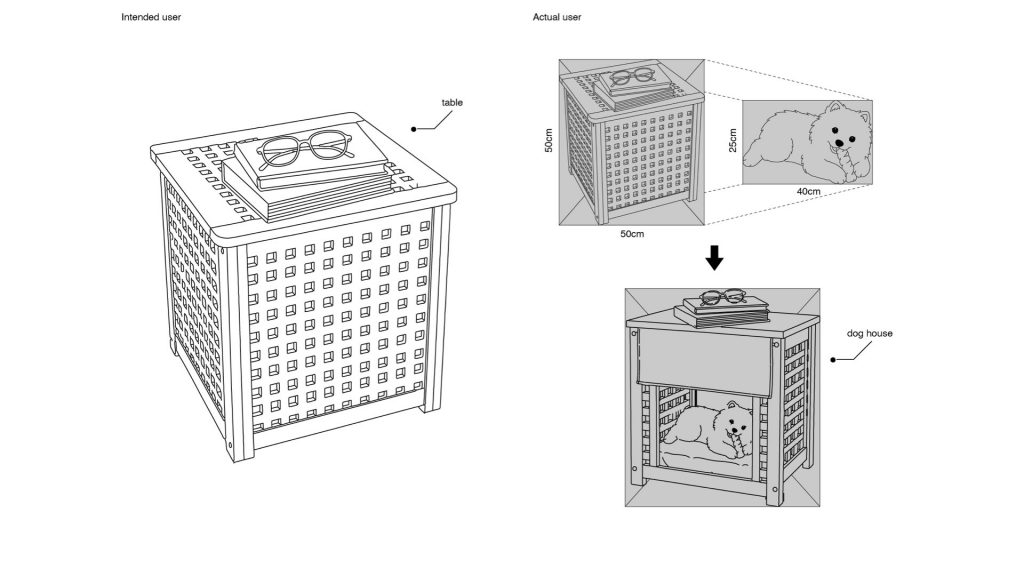
The third user transformed a coffee table into a dog house. This happened because they noticed that the size of the table matched the size of their dog. So here, scale became the key point.
These examples show that the same manual, which assumes an ideal user and a correct way of using the object, can produce very different results when it meets real users with different needs, spaces, and ways of seeing.
In the next stage, I don’t want to only collect unofficial uses of IKEA objects. Instead of only asking, “What else can this object become?”, I want to ask, “Why does this object become meaningful in this person’s space?”I want to look for more references about objects in domestic space, especially how objects relate to people’s living rhythms, housing conditions, habits, and emotional traces. This will help me shift the project from the function of objects to the way people actually live with them.
week2
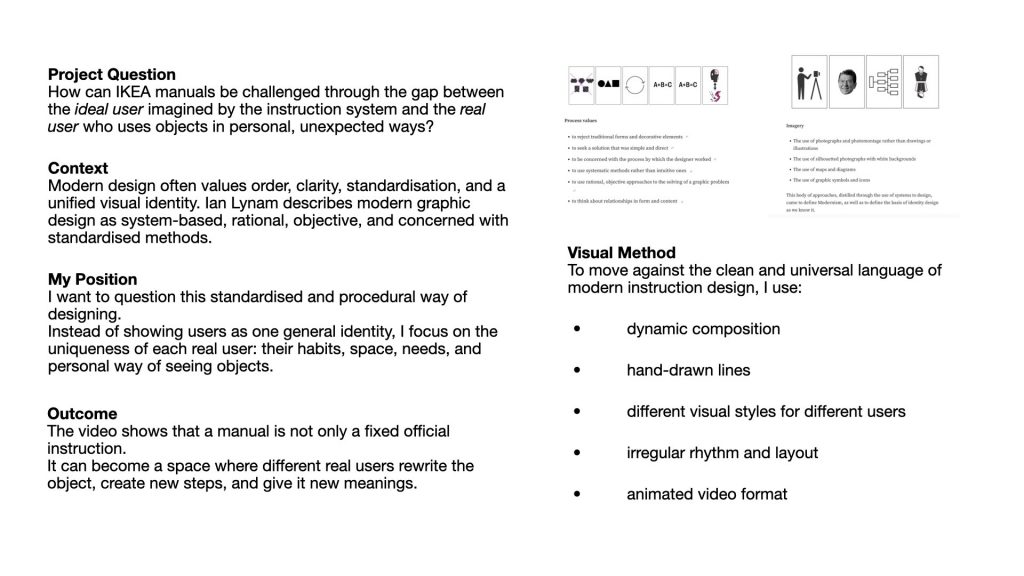
I realised that IKEA manuals are designed for a very standardised user. The instructions assume that everyone will follow the same steps, use the object in the same way, and understand it in the same logic. This kind of design comes from modernist ideas about order, clarity, and unified systems.
But through my interviews and research, I found that real users are actually very different from this imagined user. People change objects based on their own habits, living conditions, emotions, or needs. So I started to question these standardised and procedural design systems.
Modernist design often uses clean systems, sans-serif typefaces, photography, photomontage, and universal graphic symbols to create one unified identity.
So visually, I wanted to move in the opposite direction. Instead of using clean and standardised modernist visuals, I used hand-drawn elements, changing layouts, dynamic movement, and different visual styles for different users.
I wanted each user to feel visually personal and unique, rather than part of one unified identity system.
Leave a Reply